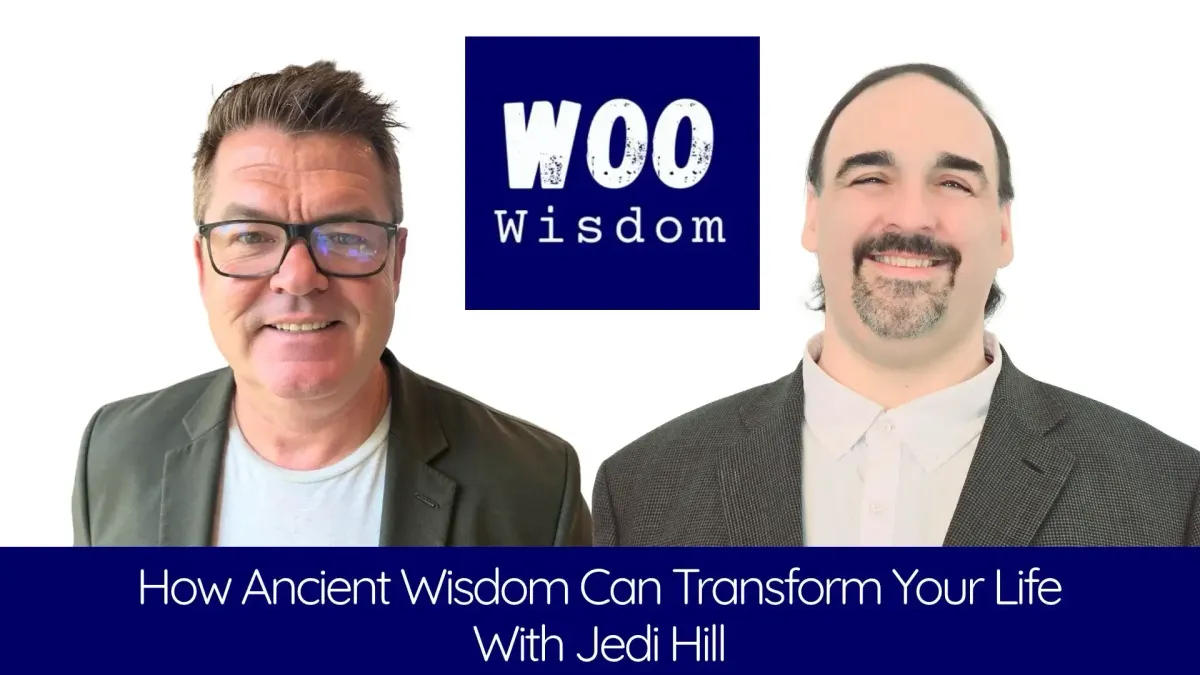
Jedi Hill on Woo Wisdom: Can Ancient Wisdom Transform Your Life?
I had the joy of sitting down with Andy Walker on the Woo Wisdom podcast to talk about alchemy, my vision quest at 16, the Daily Forge, and how ancient indigenous wisdom can help us turn fear into courage and chaos into calm. Andy also had me lead a short guided visualization, the Armor of Sovereignty, that you can try right along with us. Press play below, or read the full conversation underneath.
Listen to the Episode
Originally published on Woo Wisdom with Andy (Season 2, Episode 29). Shared with the kind permission of host Andy Walker.
Full Transcript
Lightly edited for readability (filler words removed). Speakers: Andy Walker (host) and Jedi Hill (guest).
[00:00] Andy: What if ancient indigenous wisdom holds lessons we've forgotten about ourselves? And what if alchemy isn't really about turning lead into gold, but transforming fear into courage and chaos into calm? Seneca and Mohawk author Jedi Hill draws on his spiritual heritage and extraordinary experiences to explore how we can transform ourselves. That's today on Woo Wisdom.
[00:30] Andy: Hello and welcome to Woo Wisdom. I'm your host, Andy Walker. My guest today is Jedidiah Hill, better known as Jedi. He's a Seneca and Mohawk author, healer, and modern alchemist who draws on indigenous wisdom, ancient spiritual traditions, and decades of experience exploring the relationship between mind, body, and consciousness. He's the author of Alchemy: The Masters' Path and Going from Me to We. Jedi has had some extraordinary experiences throughout his life, including a traditional vision quest as a teenager that profoundly changed his understanding of reality and our connection to one another. What I find particularly interesting is how he brings these ancient ideas into everyday life. And as you listen, pay attention to how Jedi connects indigenous teachings about finding your center, living in harmony with nature, and thinking beyond ourselves with the ancient practice of alchemy. For Jedi, real alchemy is about turning fear into courage and chaos into calm. And today, he shows us how. In the Woo Skill, we'll get a sampling of his Daily Forge practice, the relationship between physical health and consciousness, and a guided visualization that you can try for yourself. And in Woo Wisdom Plus, we venture deeper into the unexplained, from lost ancient civilizations and the mysteries of Atlantis, to Jedi's extraordinary experiences that have convinced him consciousness survives death. All right, here's Jedi Hill.
[02:17] Andy: Well, hi, Jedi. Thanks so much for being on Woo Wisdom.
[02:20] Jedi: Thank you, Andy. I appreciate it, and I love the name. So many people talk about the woo-woo and don't realize what wisdom's actually there.
[02:29] Andy: Well, you're the perfect guest for this, because what you do in the world of alchemy and the two books you've written are kind of a beautiful fit for both the woo and the wisdom here. So let's jump into it. What I really want to start with is what happened early on. I often ask my guests this because I really want to understand how they came to where they're at. And I know that at eight years old, you experienced a terrible accident that left you unable to speak for a month. Can you take me back to what happened there, and how that period of silence changed you?
[03:01] Jedi: Absolutely. I'll rewind just a little further back. I had a lisp all through my childhood. And in second grade, I lucked out and had a substitute teacher named Miss Davis that we kids all loved, because she was like 4'10", so the same height as us little kids. She noticed I was dyslexic. They got me in a speed reading course, and I had just graduated out of speech therapy right before the end of the year. And then I go to my grandparents'. We had gymnastics and stuff in school, and they took us to a park, a playground, and I did a backwards handspring on a set of monkey bars. I actually landed the jump. Unfortunately, there was dew on the bar. I slid through and hit my jaw, bit the tongue to where it was just hanging by a small thread. Went over to tell my grandmother I was okay, opened my mouth, and just blood came out. She totally freaked out, as would any grandparent you'd expect.
They took me to one hospital nearby. They said they wouldn't sedate me and sent me to a second hospital. The second hospital said they would, and then they take me back to the operating table, and I have nurses pinning down my arms and legs and another one pinching my nose to force me to open my mouth, and they just started sewing it back on. And I found out after the fact they didn't want to sedate me because they thought I might swallow my tongue, which I wish they would have just been honest with me about. It would have been a less traumatic experience as a little kid.
But after that, with the stitches, I wasn't able to speak. And my grandparents were in West Virginia. My mother was a high-risk pregnancy, so they didn't even bother to tell her. So I just stayed the whole summer at my grandparents'. Not being able to speak, you start paying more attention, because people just forget you're even there, because you're not making any noise or things like that. So I got to really observe what people are saying and the difference between what they say and what they do. You start noticing those micro facial expressions, the body language, and stuff that we don't naturally pay as much attention to.
And then my evenings I would spend reading. My grandparents were not big readers, so the only books they had in the house were the King James Bible, a dictionary, a thesaurus, and the obligatory Encyclopedia Britannica that a traveling salesman had sold them one letter at a time over several years. So I read all of those cover to cover that summer, and that really instilled a deep love of learning in me that I didn't have before.
[05:53] Andy: So you really became an observer of the world around you during that time, I imagine.
[05:59] Jedi: Absolutely. And getting to spend a lot of time in nature, you notice how quiet things are, how things just move. You start training your eyes more for tracking movement, as we did back in our hunter-gatherer days.
[06:14] Andy: And so what do you think that did for you today? Do you think that was sort of the beginnings of the sensitivity that you have, the interest in how consciousness works and how the human mind works?
[06:28] Jedi: Well, for one, you actually start to pay attention to the thoughts in your head and be more aware of them, because we all have a voice in our head, but a lot of people don't notice it. And it lets you start stepping back and increasing your awareness. So like, okay, who's thinking this thought? Who's aware? And you start realizing you're the observer, the awareness behind the thoughts, not the thoughts themselves.
[06:55] Andy: And then the mysticism went a little deeper. At 16, you went on a vision quest. So talk to me a little bit about that, because I think that gave you your life direction.
[07:05] Jedi: Yes. Well, my mother was Presbyterian, grandmother Baptist, but my dad's Native American, and he was very big on the different comparative religions. So I'd already studied Buddhism and several other cultures when I was younger. And then I had a teacher named Jim Eagle Wing who was teaching me the native ways of the pipe, and he felt it was time I needed to go on a vision quest, which is not something I'd recommend for the average person. Even back in the day, not even half of them lived through it.
You start with seven days on water, which is a very good cleansing ritual. Then they put you in a sweat lodge, which is a super hot steam room. So you get dehydrated over a few hours, and then they throw you in a lake or river. Now you're cleansed and ready for the real ritual. The instructions given to me: I had the prayer pipe with me. I was to walk deep in the woods up the mountain, find a place that called to me and felt powerful, where I could see the sunrise and sunset, and then draw a circle and stay within the circle the whole four days until you have the vision. And you were just literally no food, no water, praying for a vision from the time you wake up until you pass out every night.
On the fourth day, it's almost sunset. I'm completely parched, exhausted. I think I'm about to take my last breath, and it's like, "Creator, I've given you everything. I can't give any more." And just as I'm looking at the sun and feel like I'm about to fall over, that's when the vision, and the shapes and colors and things I saw, and possibilities of where humanity can be in the future. I'm now 28 years later, and I'm still working on understanding all I saw at that point, from the biology and stuff that I learned later on, to figure this out. What happens when you get to the point of death, the body, in a last-ditch effort to regenerate, releases all the DMT in the brain. So it's kind of like an ayahuasca trip, but much stronger.
[09:32] Andy: Sure. Yeah. An all-natural high, but in a very extreme situation.
[09:38] Jedi: Well, and the reason they have you stay in the circle is because when that vision happens, it might feel like an eternity, but it's only 10, 15 minutes. And if you wander during that point, you'll likely get lost and never make it back to the tribe, because you'll have just enough energy usually to walk back and get water and get nursed back to health.
[10:03] Andy: And when you returned, where were you at in your head? Did you get to a new place after that, or was this just a launch pad for who you've become?
[10:16] Jedi: A little bit of both. You were completely changed and transformed internally. Instead of just hearing that we're all related, we're all connected, you actually experience the energetic levels and how everything is connected to everything else. So the illusion of separation between you, me, the tree, and everything else actually dissolves at that moment. So you know the truth of reality, and you are forever changed from that point on. It's been a fascinating journey over the years.
[10:59] Andy: So how does this connect to alchemy? Let's start with the beginning. How would you define alchemy? We all know in some cases it's the medieval term for transforming lead into gold. In terms of human consciousness, can you define it for us?
[11:14] Jedi: Well, alchemy is the original, where science and spirituality were one. And it divided. It is the root cause or source of everything for understanding. Parts split off and became chemistry, physics, and things like that. Other parts split off and became religions, but both are approaching truth from those sides. And the way I see it, alchemy is a constant, conscious transformation of one thing to another. So while the ancient experts could turn lead to gold with the wave of a hand, for us it's more fear to courage, chaos to calm, gaining clarity, confidence, and things like that we need so we can actually perform and do what we need to do in the day-to-day. You hear stories of Buddhists: before enlightenment, chop wood, haul water, chop wood, haul water. And then eventually you get enlightened, and the next day you're still chopping wood, hauling water. So the physical acts don't really change. You still have to eat and do everything else, but the way you perceive them internally is what is different.
[12:25] Andy: What's the practice of it then for somebody living a North American life? They're going about their day, they're raising their family, they're making a living. They're seeking perhaps their own personal truths, or maybe they don't. Maybe they're completely numb to that, I don't know. How does this play in for the everyday American, the everyday Canadian, the everyday human?
[12:49] Jedi: Well, for the everyday human, it's taking that time with Creator every morning and night. And we know we have the conscious mind and the subconscious mind, so it's learning when and how to access those to keep us focused and get the intuition from the still, silent voice within. So my very first thought every single morning is, "Thank you, Creator, for another day with my honey," my significant other, Anna. And then just feeling the gratitude for everything good in your life before you start focusing on what you need to do and set your day.
[13:29] Andy: I hear a lot of ancient wisdom, and I would suggest perhaps what you got from your father's lineage, the indigenous wisdom of the world, in what you speak. You seem to live it. Is that your center?
[13:50] Jedi: Yeah, and that's why in my first book, Alchemy: The Masters' Path, one of the chapters is purely returning to center, because we're going to have things in life throw us off. You have somebody cut you off as you're driving to work, you get in an argument with somebody, and all these different things throw us off. But it's returning to that calm, still center. And being Seneca and Mohawk, part of the Iroquois Confederacy, the People of the Longhouse, we call ourselves the Haudenosaunee. And we had what was known as the Great Law of Peace, which is what Jefferson and Franklin and them used to write the Articles of Confederation, which is what our Constitution is based off of. And before every meeting and connection, everybody would take the time with the prayer pipe and would be coming back to that calm center. So you can actually have discussion, and all your decisions are based on what the effect is going to be seven generations from now. Not six months, a year, five years, 10 years, but a longer timeframe. And we need to get back to that longer, forward thinking.
[15:07] Andy: And so in your book, you have something called the Daily Forge. So tell us a little bit about what that is, and what would a typical morning practice involve? Because I'm gathering it's designed around getting to that inner peace, that inner state that you've just been talking about.
[15:27] Jedi: Yes. The Daily Forge is broken into four parts. The first part is, when you can, physically getting your feet on the earth and grounding out, which biochemically gets the free electrons flowing in through the feet, which has an antioxidant effect, which reduces swelling and inflammation throughout the body. So making the body feel better makes it easier to calm the mind. And you can still do it with visualization, but whenever you can get your bare feet on there, it's a good thing for your health.
The next step is I do the Hollow Bone ritual, which is where you are calming yourself down with slow, deep breaths, connecting to Creator, and cleansing and pulling out all the angers and frustrations and everything within you that prevents you from being a hollow tube or channel for Creator, to serve something greater than yourself.
And then the next step is the Armor of Sovereignty, where you are protecting your energy field, because we are basically giant saline batteries with transducers and receivers, similar to your ham radios. So if you don't protect your energy, you're more easily bumped off center by what's going on around you.
And then the last part is focusing on whatever your grand vision is, because as King Solomon said, without vision, the people will perish.
[16:58] Andy: So it really sounds like it's an inner cleansing, and it sounds like it's connected to healing your physical body too. What's your take on that?
[17:06] Jedi: Well, with the Hollow Bone ritual, I actually learned that when I was given the book Fools Crow: Wisdom and Power by one of the elders when I was a kid, and that is the ritual he would do to cleanse himself before any other healing ceremony. And with the healing, you're thinking healing, healing, healed, having to see it as already done, and everything stitching back together and restored to what you need. Then the fasting time: even Jesus fasted for 40 days. My personal max is 28 days. That's the longest I've gone on water without food. Haven't done the 40 yet.
[17:49] Andy: That must be transformative, though. I'm gathering you drink water only, and that's about it. Is that right? For 28 days?
[17:59] Jedi: The body, you do lose some weight and muscle mass a little bit, but the mind is so much clearer. The little things that distract you in the day-to-day just start to go away. I know you've probably heard a lot of people talk about things like the monkey mind and the reactive mind, where you're thinking, "Oh, what if this happens? What if that happens?" Blah, blah, blah, going on in people's heads. But you don't have to do that. You can get to the point through practice where it's completely quiet up there. You only have thoughts when you are actively thinking about what you need to do, or you're trying to figure out some problem. The rest of the time, it's quiet.
[18:43] Andy: Let me ask you this. Of all the practices that you have, because you sound like you have developed some really intriguing, I would say, mind hacks almost, but it's consciousness hacks, really, isn't it? Would that be fair, to characterize these things that you do as consciousness hacks?
[19:00] Jedi: It's both, because you can use your biology to change your psychology, or you can use your psychology to change your biology. You can do it both ways. I originally trained as a massage therapist, studied with osteopaths, chiropractors, acupuncturists. I've treated over 20,000 people and had done omnilateral physiotherapy, which aligns every muscle and joint in the body to just reset the whole being in about 10 minutes. And the amount of emotional releases I've had on the table, where past traumas and things let go as you're fixing the body, is just outstanding and amazing to me every time I see it. But on the flip side, if you deal with your emotional traumas, because you have to feel it and actually process it through to heal it, the physical can heal as well. It's all connected.
[19:57] Andy: I mean, that's the conventional wisdom. Certainly a lot of the practitioners that I talk to believe that once you settle the mind, the body follows. And perhaps you have an interesting take on it in the reverse: if you get your body in shape, your mind follows. Perhaps it's all kind of balanced, isn't it?
[20:13] Jedi: Well, that's where, with many cultures, like Japan and China, they're so big on the qigong, the tai chi, and starting with the physical movement to discipline the mind. And it's actually easier to do it that way than it is to discipline the mind to discipline the body.
[20:36] Andy: I can relate to that. It's interesting. This is going back several years now, but I got into my fifties and got very unhealthy and too overweight, and I started a daily walking practice that led to meditation. But what I found was the meditation process was not possible until my body was healthier. There was something about the way that my body was that wouldn't let me go into that magical middle space in my mind. It was too many distractions, too much discomfort, too much physicality. I don't know how to really explain it. But once I started walking several miles a day as a regular practice, meditation came easy for me.
[21:20] Jedi: Yeah. When your body calms down and it's not sending you all those fears and aches and pains, it's much easier to be in a good mood.
[21:30] Andy: That's true. So true. Fascinating. You put a lot of emphasis on breathing, awareness, obviously with the meditations you talk about, and then changing our habitual reactions. How do those all tie together? Do you have a common thesis about all of this?
[21:50] Jedi: Well, the ancients say the fastest way to ascension is through the breath, and the second by service. We understand that all of our emotions are held in our breath. The people who have really high anxiety and nervousness, they're very much upper chest breathers. They're not taking a full, deep breath, so they feel like they're hyperventilating and have messed with their oxygen-carbon dioxide ratios in their blood, which makes them more anxious, because you're constantly in that fight or flight. By breathing slowly, making your exhalation longer than your inhalation, you stimulate the vagus nerve to take you from fight or flight back to rest and digest. Which is why with most people I've worked with, I usually have them start with a simple breath in for a count of four, one, two, three, four, and out for a count of eight, one, two, three, four, five, six, seven, eight. And counting it in and out has the added effect that it gives you something to focus your mind on instead of what you're panicking about, while you are forcing yourself to go through the deeper, slow breathing. And within a minute, minute and a half, most times you have calmed your nervous system down enough that you can start to think rationally and logically again.
[23:13] Andy: Yeah, I've done some breath work myself, especially at a retreat in Sedona at one point, and I had the most mystical experience. They called it a rebirthing or something like that, where it felt like I was up to my ears in toxic waste as I went in, and then sort of was purging it through my toes through the whole breath session. It was actually a little terrifying, to tell you the truth. What do you think was going on there?
[23:42] Jedi: Well, it is fascinating. I don't know which breath work they were having you do specifically. Sometimes you're doing faster, deep inhalations. And when you look into the yogic masters, they can actually use different types of breath work to milk each specific organ. So you're doing some of the deeper breath works, you start milking the kidneys and the adrenals to pump and increase the heart rate. You'll do other ones where you can squeeze out some insulin, or some bile out of the gallbladder and liver, all through breath work. So your potential for changing your biochemistry and hormones is limitless with different types of breath work.
[24:23] Andy: Yeah, it certainly was. I saw my dead father-in-law, who had passed the previous year. I had all kinds of mystical experiences. I think it was a fast intake, a hold at the top, and then a slow, sort of like what you just explained, four in, hold at the top, and eight out kind of thing. But I was in it for 45 minutes to an hour, and so I almost felt out of body. It almost felt like I wanted to go, but I was just trying to push whatever toxicity I felt in my body out of my toes. It was a very strange experience, but I love how all this ties together. And you've brought a lot of concepts to us here, but for anybody who's listening to this and going, "Wow, all these things are great. How do we tie it together?", where do they start if they wanted to start to use some of these practices? What's your advice to the brand new beginner, or somebody who's like, "Now I'm interested in this. What do I do first?"
[25:22] Jedi: Always just start with making the exhalation longer than your inhalation. Anytime you're stressed or anxious, go back to the earth, get your feet on the ground. The more time we can get in nature away from civilization, the better off we are. And I used to say when I was younger, I was like allergic to civilization. And now that I know how much they've poisoned the food and water and everything else, it really does make sense.
[25:50] Andy: Oh, yeah. And you live on a sailboat, at least currently?
[25:56] Jedi: Yes, currently living on a sailboat, traveling the country. And I spend as much time in the woods as I can, getting your feet on the beach like we did this morning. And the sand has that piezoelectric effect, so you're getting the extra electrons into your body. And just take each day one step at a time, and don't sweat the small stuff. And remember, it's all small stuff.
[26:23] Andy: That's great. Well, we said we were going to leave a Woo Skill in this episode, and you're going to lead us through a brief exercise. What are we going to do today?
[26:34] Jedi: Let's go ahead and do the Armor of Sovereignty. It's a very quick visualization.
[26:40] Andy: Okay, so let's do this one together. If you're driving, just listen for now, and otherwise get comfortable, close your eyes, and follow along with Jedi. This only takes about a minute or so.
[26:52] Jedi: So what you are doing: you take a couple of deep breaths, and then you're going to imagine a golden light coming down and coating your vessel, your energy field. And gold in alchemy is your highest, your purest metal. It's indestructible.
And then on top of that, you'll visualize a purple light, a violet flame coming down, which is seen as a very healing color, with the ultraviolet.
And then you'll see the blue light of truth coming over that. So you speak truth, and only truth gets to you.
And then over top of that, you'll have your white light, which a lot of people see as your protective, and all your different colors coming from the sun.
After the white, you do another layer of gold to seal everything in.
And the way the visualization works is you're just creating a more stable energetic field for your body, so you don't get fluctuated as much by what's going on externally.
[28:31] Andy: Is there a reference where you can send people? What's the best way to reach people?
[28:35] Jedi: Yeah, they can totally find it here in Going from Me to We. For all your listeners, if you go to newatlantisdevelopments.com/dailyforge, the Daily Forge chapter and all the charts and everything are given for free. So you don't even have to buy anything.
[28:57] Andy: Oh, very good.
[28:58] Jedi: Totally check it out.
[28:59] Andy: And what's your practice? Do you take clients? Do you do coaching? What's the thing that you do to take your work into the public?
[29:07] Jedi: I do take some coaching clients, and I'm working on developing the guild system and New Atlantis Society, to gather other like-minded people who take personal responsibility for their lives and want to actively work on making the world a better place. Because nobody's coming to save us, and we've got to do it ourselves.
[29:28] Andy: How can people get a hold of you?
[29:30] Jedi: NewAtlantisDevelopments.com, or they can find me on Facebook at Jedi Hill, or X at AlchemistJedi.
[29:39] Andy: Well, thank you, Jedi, for being with me this week. It's just been a fascinating conversation.
[29:43] Jedi: Thank you so much, Andy, and thank you for having me out here on Woo Wisdom. It's really great.
[29:48] Andy: All right, folks, well, that's it for us. Thank you for tuning in this week. As you know, my name is Andy Walker. This is Woo Wisdom. Don't forget, stay in the Woo.
[29:57] Andy: Want to go a little deeper into the Woo? Join Woo Wisdom Plus on Patreon for extended interviews, bonus conversations, and more of the fascinating stories and ideas we don't always have time to explore in the regular show. Your support helps keep Woo Wisdom going. For more information, go to WooWisdom.com and click the Woo Wisdom Plus button in the top right-hand corner of the homepage to become a member. And if you like video, check out Woo Wisdom on YouTube. It includes additional content, video clips, and select interviews. You'll also find every episode, show notes, and guest resources at WooWisdom.com. Woo Wisdom is hosted and produced by Andy Walker, a production of Cyberwalker Media. All rights reserved.


